
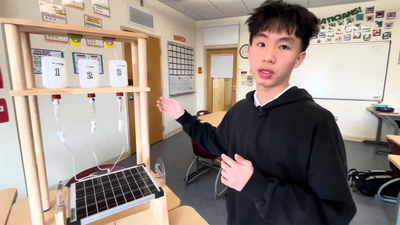
At just 13 years old, Jason Chang, a seventh-grader from Worcester Academy in Massachusetts, has designed an impressive solar tracking system that costs under $25. This device has demonstrated the capability to generate approximately 20% more voltage compared to standard fixed solar panels during outdoor tests. Unlike traditional systems, Jason’s invention uses gravity, water-filled containers, and a seesaw mechanism to follow the Sun’s movement without relying on motors or electricity.
The inspiration for this project emerged when Chang became frustrated with having to constantly adjust his family’s solar-powered Christmas lights. As a result, he developed a system that adjusts a solar panel’s angle throughout the day, enhancing its efficiency. Conventional fixed panels can miss optimal sunlight angles as the Sun moves across the sky, potentially losing up to 20% of energy. Jason’s design addresses this issue with a mechanical system that operates independently of external power.
How the Solar Tracker Works
Chang’s innovative design relies on a controlled flow of water to shift weight and tilt the solar panel as it tracks the Sun. By pulling a plug, water flows and gradually fills a bucket, causing the panel to tilt in response. This straightforward mechanism, constructed from simple and often recycled materials, is not only cost-effective but also easily replicable around the world.
Proven Effectiveness
Instead of just theorizing about his design, Chang conducted outdoor tests to compare the performance of his solar tracker with that of a fixed panel. His results showed that the solar tracker produced roughly 20% more voltage than its stationary counterpart. However, it is important to note that this increase was measured under specific testing conditions and should not be interpreted as a blanket 20% boost in overall electricity generation.
Future Aspirations and Challenges
Jason’s project aims to enhance electricity accessibility globally, especially in off-grid communities and regions affected by natural disasters. He hopes that the affordability of his design can provide solutions where electricity is scarce. Despite his success, Chang faced challenges during development, especially with the fluid-control mechanism, which required precise measurements for optimal performance. He noted, “The hardest part was the fluid control frame,” emphasizing the need for accuracy.
Another limitation of the current design is its performance in cold weather, as freezing temperatures can hinder its operation. To address this, Chang is working on a version that can function effectively in winter conditions.
Recognition as a National STEM Champion
Jason’s innovative work has garnered national attention, earning him the title of National STEM Champion and an opportunity to present his invention in Washington, D.C. During a special moment captured by CBS Boston, he received a congratulatory video message from Jenny Buccos, co-founder of the National STEM Festival, who praised him as one of “the 55 reasons to believe the future is in incredible hands.” His classmates celebrated this achievement, marking a significant milestone in his young career.
Expressing his excitement, Chang stated, “I feel great,” and shared his future aspirations of becoming an entrepreneur focused on creating helpful products. His solar tracker exemplifies a blend of simplicity, innovation, and potential impact, and he continues to refine the design for better cold-weather performance as he prepares for his national presentation.