
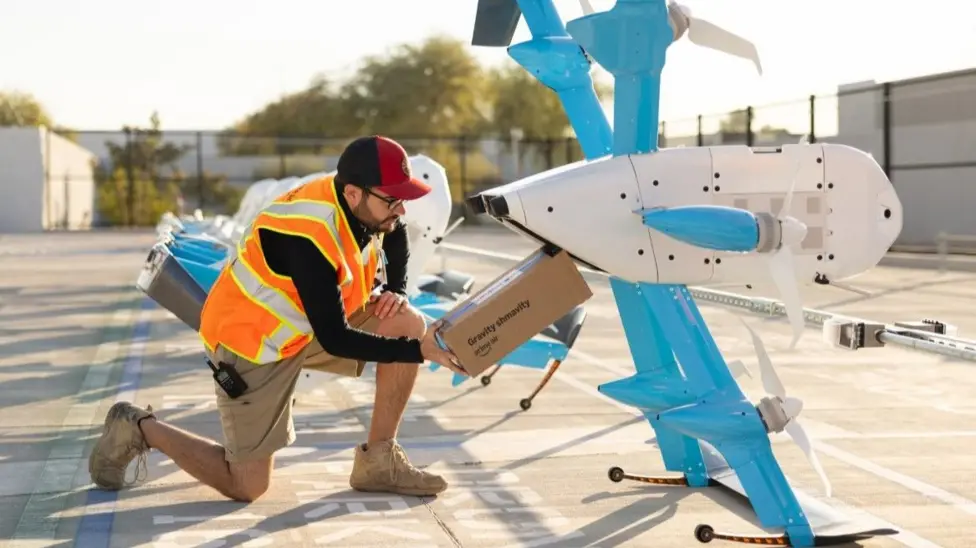
Residents like Schmidt are becoming increasingly aware of the drone noise generated by companies such as Amazon and Walmart as they enhance home delivery services. Once viewed as a novelty, delivery drones are now integral to daily life in many U.S. cities. Amazon Prime Air is expanding its service to nearly 500 locations, delivering items that fit in a shoebox-sized package. The service has also recently launched in areas around Darlington, England. Smaller delivery services are emerging as well, allowing customers to order items like pizza or ice cream via drone.
Even in bustling urban environments, the distinct noise of drones can be particularly irritating. While traffic sounds tend to blend into the background, the abrupt whine of drone rotors stands out. According to Antonio Torija Martinez, professor of acoustic engineering and psychoacoustics at the University of Salford, this type of noise is especially noticeable when overall sound levels are relatively low.
Unlike larger aircraft, drones fly at lower altitudes and may traverse over residential neighborhoods. “They can introduce significant noise to communities that previously experienced little to no aircraft sounds, making them more sensitive to changes in their acoustic environment,” explains Torija Martinez. Research indicates that individuals are more likely to react negatively to noise perceived as ‘novel, intrusive, or frequent.’ As a result, those benefitting from drone deliveries may be less disturbed by the noise. However, he warns that complaints about drone noise are expected to rise: “Currently, these issues are localized, but the expansion of the drone sector will likely lead to an increase in complaints.”
In the U.S., the Federal Aviation Administration (FAA) oversees commercial drone operations, but it has faced criticism for permitting loud drone delivery services. The FAA states that the responsibility for addressing community concerns lies with operators and local leaders.
Could advancements in technology reduce this bothersome noise? Greenjets, a startup based in London, is striving to address both the noise level and its frequency. According to Darren James, the company’s future technologies lead, Greenjets has developed a propulsion system that can decrease drone noise by at least two-thirds. Traditional drones utilize spinning propellers that generate a high-pitched buzz, while Greenjets encapsulates these blades within a pod to muffle sound and direct it away from the ground. Their system also minimizes noise through slower rotor speeds and the use of vibration-dampening materials.
Creating quieter drones is not only about alleviating noise for frustrated neighbors; Greenjets’ technology is also employed by police and harbor security in Germany and aids conservationists in Africa who need to monitor poachers discreetly. Additionally, military operators have a vested interest in minimizing noise levels to remain undetected. “There are ongoing efforts to reduce drone noise, with U.S. Special Forces currently exploring this at an experimental level,” states Robert Tollast, a research fellow at The Royal United Services Institute (RUSI). However, he emphasizes that speed often takes precedence over stealth in larger military drones, particularly in the ongoing conflict between Russia and Ukraine.
Greg Sharrow, an entrepreneur from Detroit, was inspired to design quieter drones after encountering challenges while filming a classical music performance in 2012. Realizing that the propellers were the primary source of noise, he asked himself what a tipless propeller might look like and how it would function. This led to the development of a unique twisted loop-shaped blade design that lacks pointed tips. Initially, he tested his concepts with boat propellers but is now focused on producing ultra-quiet drone rotors through his company, Sharrow Engineering. “We have confirmed that our technology is effective in drone applications and significantly reduces noise,” he shares.
Companies leading the drone delivery industry are also working towards quieter fleets. An Amazon spokesperson stated that they have made “measurable sound improvements” and that their latest drone models feature specially designed propellers that cut perceived sound levels by nearly half. Wing, the drone maker for Walmart deliveries, claims that its propellers are engineered to minimize noise and that it adjusts flight paths to avoid repeated overflights over neighborhoods.
For residents like Schmidt, who are weary of drone noise, the ideal resolution would be to suspend drone deliveries in her vicinity. “I wish they would completely halt operations until they can ensure their services are no longer disruptive,” she expresses.