
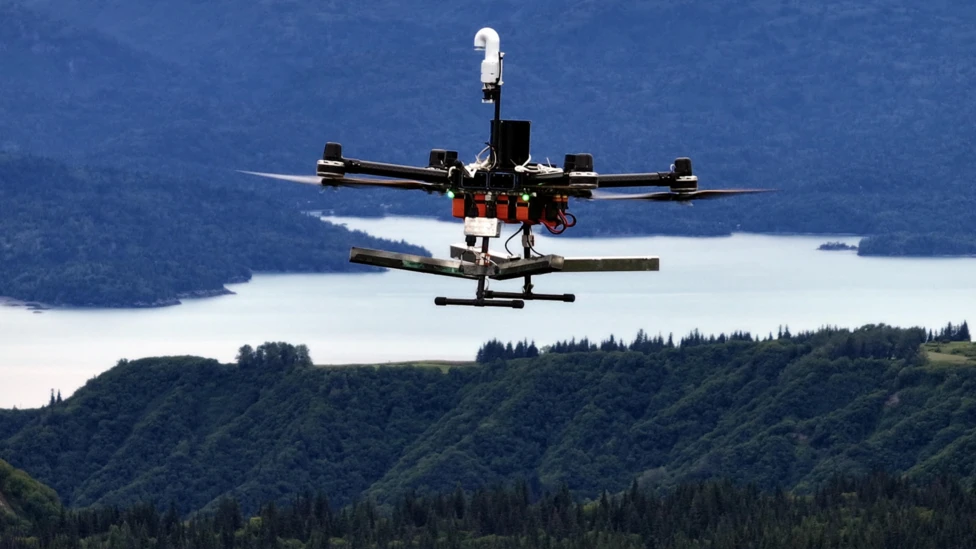
On August 23, Cooper Freeman was unaware that above him, clouds were being treated with a silver compound to induce rainfall. Many residents in Homer, Alaska, were similarly uninformed about an experiment conducted by a start-up named Rainmaker, which utilized cloud-seeding technology in the area. Based in El Segundo, California, Rainmaker claims to have generated 19 million gallons of water in the atmosphere within just three hours.
This weather-modification technique, which has been in practice for over 80 years, employs planes and drones to disperse compounds like silver iodide into clouds, facilitating the formation of ice crystals. These crystals grow large enough to precipitate as rain or snow, depending on the ambient temperatures. Essentially, cloud seeding accelerates the natural condensation process of water vapor in clouds, with gravity pulling the resulting crystals down to the ground.
However, the effectiveness of this technology is contingent upon favorable climatic conditions, particularly in mountainous or colder regions like Alaska. Freeman, who heads the Alaska branch of the Center for Biological Diversity, expressed concern that residents were not adequately informed about these experiments. He raised questions about the safety of the materials used in the cloud seeding and their potential impact on both people and local ecosystems. “There doesn’t seem to be any downstream monitoring to ensure that this silver iodide didn’t harm the environment,” he noted.
Freeman also emphasized that relying on a company to conduct cloud seeding will not address the critical issues surrounding water conservation. His sentiments align with warnings from UN Secretary-General António Guterres, who stated in July that the world is consuming freshwater faster than it can be replenished. Recent reports highlight that the past five years have experienced the lowest water levels in global rivers in over 30 years.
While cloud-seeding technology may provide limited assistance, it is not a panacea for water shortages. For instance, Rainmaker’s claim of generating 19 million gallons translates to merely about 0.01 inches of rainfall over an area of 100 square miles. Despite this, more than 50 countries are exploring weather modification programs, and a wave of start-ups is focusing on rain generation technologies.
As promising as the cloud-seeding industry appears, it grapples with significant questions regarding safety and effectiveness. Companies are continually refining their methods, including the choice of materials used for cloud seeding and the techniques employed.
Augustus Doricko, the founder and CEO of Rainmaker, is well-prepared to address inquiries regarding the safety of using silver iodide. He asserts that Rainmaker releases 20 grams of this compound per flight, dispersed over vast areas. “The resultant concentration on the ground is in the parts per quadrillion, far below the FDA’s allowable threshold,” he explained.
Rainmaker’s drones are designed to ascend into clouds since the process cannot commence without them. The company uses silver iodide flares that, when ignited, atomize water particles to a size that allows them to remain suspended in cold clouds for extended periods, ultimately forming crystals that lead to rainfall.
Operating in states such as Idaho, Utah, and Colorado, as well as regions in the Middle East like Jordan, Doricko stressed the dire water scarcity in such areas, where residents may only have access to utility water for a few hours each week. “It’s a privilege to assist this historic region,” he stated.
The origins of cloud seeding trace back to 1946 when researchers at the General Electric Research Laboratory first used dry ice as a seeding agent. A year later, silver iodide was identified as a more effective alternative. Although these seeding agents can increase rainfall, their overall impact remains limited, with statistics indicating that cloud seeding can only enhance precipitation by about 5 to 10% under ideal conditions, according to Jon Meyer, assistant state climatologist at the Utah Climate Center.
Nevertheless, a pivotal study in 2017 demonstrated that silver iodide performed as expected, marking one of the first successful observations of cloud seeding using radar and precipitation gauges. Meyer has noted a positive trend in the cloud-seeding sector as more companies like Rainmaker introduce innovative solutions to this traditional industry. “Drones, such as those from Rainmaker, offer a new approach, allowing for more targeted interventions with clouds that we hope will respond effectively,” Meyer concluded.