
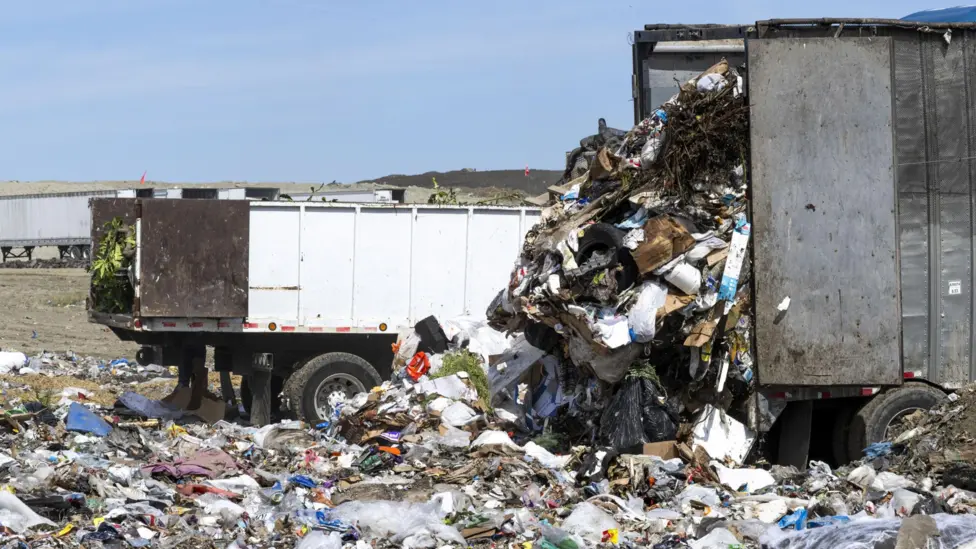
In Milpitas, a prosperous city in California’s Silicon Valley, residents face a persistent smell problem originating from industrial sites, including a large landfill spanning 342 acres. Engineer Chia-Ling Kong, who lives near the dump, recalls, “When I first moved here, I could not open my window for over 10 years.” Although conditions have improved, Kong and her neighbors still experience unpleasant odors for two to three hours daily.
In a bid for relief, the community is turning to technology for assistance. Local authorities have mandated that Newby Island landfill employ drones and install monitors to accurately track and assess the chemicals causing the foul smells. Additionally, the landfill operators are required to automate the collection of gasses contributing to the odor problem. Kong is hopeful that ongoing monitoring will facilitate quicker identification of issues as they arise.
The landfill operators assert their commitment to safe operation and air quality protection. Communities worldwide, similar to Milpitas, are voicing their frustrations over unpleasant odors affecting their quality of life. Whether due to a landfill, sewage treatment facility, or a foul-smelling factory, the challenge of addressing these complaints can be complex, especially as many countries lack specific regulations for managing odors.
In the United States, for instance, the Environmental Protection Agency does not classify environmental odors as pollutants, leaving it to state and local governments to address the issue. Urban expansion often exacerbates the situation, bringing residential areas closer to odor-producing facilities that were once distanced from neighborhoods.
Consequently, there is a rising demand for technologies aimed at monitoring and preventing unpleasant smells. Odor consultant Micheal Bull notes that communities are increasingly concerned about odors as developments arise near sources of unpleasant emissions. He explains, “You’re getting developments being built nearer to odorous processes… as land has become more valuable, there is also infilling.”
Technological solutions for industrial odors typically fall into three categories: odor absorption, chemical conversion to reduce odor, and combustion to eliminate odors. Experts suggest that when implemented correctly, these technologies can remove over 90% of the odor-causing compounds. However, some operators may resort to simpler and more cost-effective measures, such as using large amounts of deodorizers to mask odors. Experts express skepticism regarding the effectiveness of these methods, with Bull comparing them to fabric conditioner.
Resolving odors from waste sites, which are frequent sources of complaints, can be particularly challenging. Carlos Diaz, an environmental consultant from Spain, highlights the difficulty in treating landfills due to their vast surface area.
Nonetheless, technology is proving effective in some areas. In Des Moines, Iowa, residents have long complained of the “Eastside Funk,” a noxious smell affecting parts of the city. City authorities commissioned a study revealing that several industrial meat companies were contributing to the problem. Dalton Jacobus from the Department of Neighborhood Services notes, “If the winds are out of the wrong direction, 100,000 people can be in the middle of that odor plume.” To address the issue, the city has invested approximately $240,000 annually in technology to monitor odors, allowing officials to take informed action.
The monitoring system, which includes devices that measure chemical compounds in the air, works alongside a weather station to provide real-time data based on wind patterns and concentrations from each facility. This technology has effectively eliminated the blame game regarding odor complaints, enabling authorities to identify the precise source of odors.
In Des Moines, several facilities linked to unpleasant smells have spent millions on upgrading their odor control systems. Smithfield Foods, operating a meat processing plant in the city, has invested $2 million in a regenerative thermal oxidizer to destroy odor-causing chemicals, although the company maintains it is not the source of the complaints.
Prior to the installation of monitoring systems, officials would personally attend the site of complaints to assess odors manually. Claudia Barrios Obregón from Kunak, the company behind the Des Moines monitors, states, “Currently, cities measure odors using olfactometry: a human panel assesses and provides feedback on the smell. But this method is not entirely realistic.” The electronic noses developed by the Spanish company offer a more reliable means of odor detection.
Regardless of the technology employed, maintaining universal satisfaction can be difficult, as perceptions of smell vary widely. Johan Lundström, a professor at the Karolinska Institute in Stockholm, Sweden, notes, “Unfortunately, the general rule is that the nastier we perceive the odor to be, the more sensitive we become to it.”