


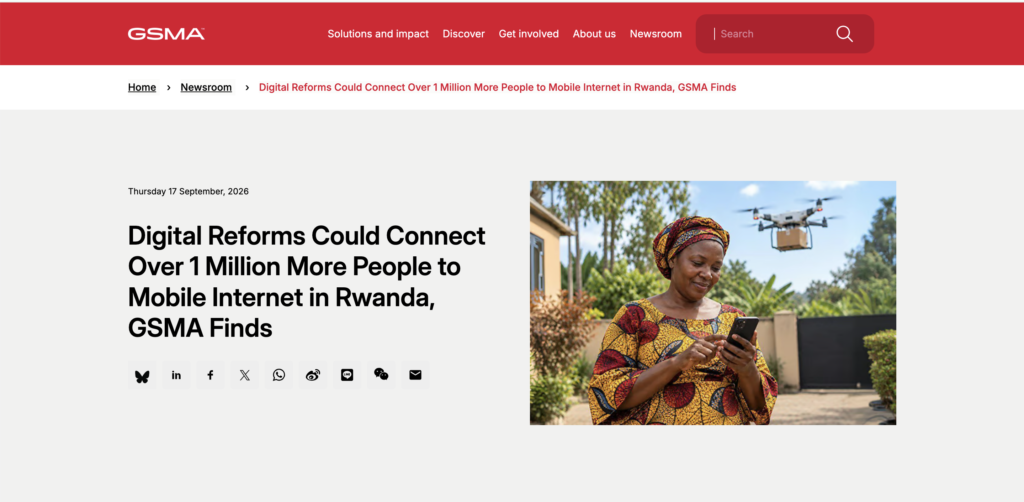
More than one million additional people in Rwanda could gain access to mobile internet by 2031 if targeted reforms make smartphones and digital services more affordable and accessible, according to a new report from the GSMA.
The report, Rwanda Digital Economy: Policy reforms that will drive Rwanda’s digital future, estimates that proposed reforms could result in approximately 1.07 million additional unique mobile internet subscribers by 2031, representing 22.1% more subscribers than projected without the reforms. GSMA
Rwanda has coverage, but usage remains low
Rwanda has made significant progress in expanding its telecommunications infrastructure. According to GSMA, around 96% of the population is covered by 4G networks, while 3G coverage reaches approximately 99%.
However, only 21% of Rwanda’s population were unique mobile internet subscribers in 2025. GSMA
This creates an important distinction between having mobile internet infrastructure available and people actually being able to use it.
GSMA identifies smartphone affordability, limited digital skills and a lack of sufficiently relevant digital services as some of the barriers preventing more people from getting online, particularly in rural and lower-income communities. GSMA
Making smartphones more affordable
One of the report’s major recommendations is improving access to affordable smartphones.
GSMA recommends expanding private-sector device financing targeted at lower-income and rural households, while assessing whether taxation and other costs are limiting smartphone adoption.
The organisation argues that having extensive 4G infrastructure will not deliver its full economic and social benefits if large parts of the population cannot afford the devices needed to access it. GSMA
Digital skills are also important
Affordability is only part of the challenge.
GSMA says Rwanda should strengthen practical digital-skills programmes, particularly for rural communities.
Rather than focusing solely on basic internet access, training could help people understand how digital technology can be used in everyday activities such as accessing financial services, agricultural information, healthcare and government services. GSMA
More Kinyarwanda digital content
The report also highlights the importance of locally relevant digital services.
GSMA recommends expanding applications and online content available in Kinyarwanda, while making useful government and other digital services easier for citizens to access.
Feature-phone users should also continue to have access to essential services as Rwanda moves towards more advanced mobile broadband services. GSMA
Potential RWF 218 billion annual fiscal benefit
The economic impact could also be significant.
GSMA estimates that increased digital adoption and the resulting economic activity could produce a net annual fiscal benefit of approximately RWF 218 billion by 2031.
The organisation argues that the additional economic activity could more than offset the cost of targeted tax reductions and other measures designed to improve affordability. GSMA
Four areas identified for action
GSMA’s recommendations centre on four areas: making smartphones more affordable, improving practical digital skills, expanding relevant and accessible digital services, and maintaining affordable and sustainable connectivity.
The report also points to electricity costs as an issue because they contribute to network operating expenses and can ultimately affect the cost of providing connectivity. GSMA
Closing Rwanda’s digital usage gap
The findings highlight an important next stage in Rwanda’s digital transformation.
Building mobile infrastructure has significantly expanded the availability of connectivity. The challenge increasingly becomes ensuring that people can afford smartphones, have the skills to use digital services and can find online services relevant to their everyday lives.
Closing that gap could bring another million Rwandans into the mobile internet economy over the next five years.
Read the official GSMA announcement

