


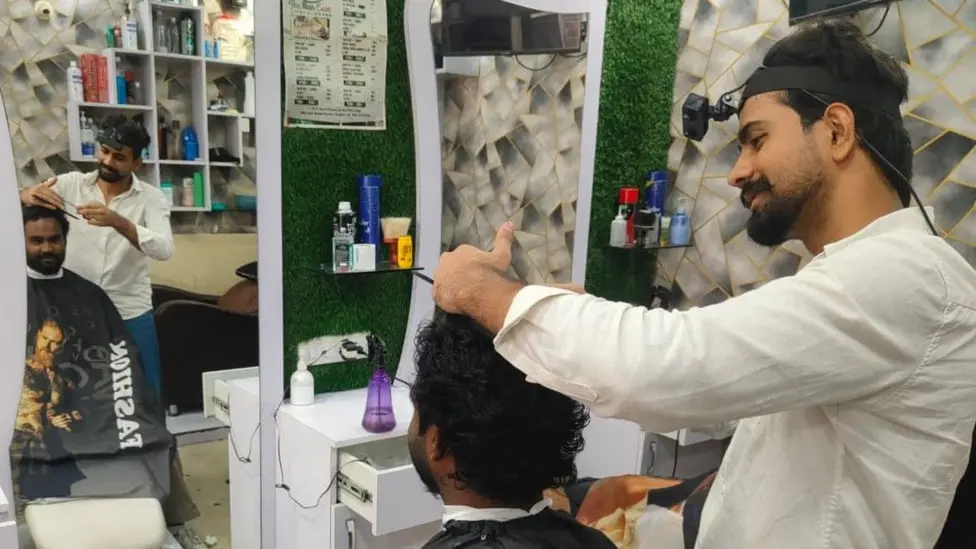
Mohammed Ashim, a 22-year-old barber from Bengaluru, has been in the hair cutting business for four years. Recently, he has taken on a new role by strapping a camera to his head to film his work. The camera focuses solely on his hands, ensuring clients’ faces remain blurred. “The routine is simple, but discipline in movement is crucial. The operations team instructed me to keep my hands within the frame, ensure sharp lighting, and avoid abrupt head movements while working,” Ashim explains.
He records footage for five to six hours daily, stating, “It’s good money, but the thrill of engaging in something so futuristic is what truly excites me. I never thought my skills with a razor would contribute to a global tech firm.” Ashim is among hundreds of thousands worldwide who are compensated for documenting their tasks. His videos are collected by a local company that employs numerous individuals for similar filming. This footage is then sold to technology firms and research organizations, particularly for training artificial intelligence in the realm of physical AI, which enables robots to function in real-world settings.
Shahil Baig, co-founder and CEO of Rashdan Technologies, notes, “Every robotics company and AI lab has specific data needs, whether it’s for industrial tasks, agriculture, household chores, or small business operations like pottery and garment-making. We go wherever the work is.” The company compensates workers between $5 to $10 (£3.74; £7.47) for eight to ten hours of recorded labor, which is significant for many of these individuals.
Baig emphasizes the importance of ensuring that workers consent and feel comfortable throughout the process. “We record hands, not faces, and if multi-camera setups capture more of the body, we blur faces. No personal identifiers are included in the data we deliver.” However, as client demands grow, they are now requesting four to six cameras to encompass the entire scene, complicating the consent process. Baig states, “Getting someone to agree to one small camera is one thing; persuading them to wear a five-camera headset is a different, more challenging conversation. We offer higher pay for this level of data collection due to the complexity of the request.”
The industry is becoming increasingly competitive, with Baig anticipating a surge of new entrants in India this year.
Why Is This Data Crucial?
Manish Agarwal, founder of Humyn Labs, explains the necessity of this data for robots navigating the real world. “They cannot be solely trained through computer simulations. Most data is derived from video, yet sometimes, collectors wear devices on their hands and fingers to capture physical interactions. Physical tasks demand high-quality signals that involve various limb movements and force applications, such as determining the right grip pressure for different materials,” he says.
Until recently, such data was scarce. “There is no existing internet archive of embodied human activities—a dataset of a kitchen being cleaned or a car being assembled by skilled hands. This data must be collected from scratch in real-world scenarios across diverse environments,” Agarwal elaborates. His company currently has 96,000 data collectors in regions across Latin America and Southeast Asia.
Humyn Labs sifts through thousands of hours of video from these collectors, selecting the most relevant content, labeling it for AI recognition, and packaging it for client use. “Sourcing data from various factories and tasks in different geographies is essential, especially when developing robotics solutions for US markets, as environments in India may not be suitable for that context,” he adds.
Concerns About Job Displacement
Some question whether workers are unwittingly preparing data for machines that could eventually replace them. Bino Paul, a senior professor at the Tata Institute of Social Sciences in Mumbai, remarks that while AI could serve as a beneficial tool for some, it may also automate jobs. “If machines begin to take over, workers may find themselves powerless to change the situation,” he warns. He advocates for government regulation of AI, asserting it should not be viewed merely as a technical issue but as part of a larger socio-technical system that upholds ethical standards and ensures AI’s positive impact.
Despite apprehensions regarding AI’s trajectory, investments in its development continue to flow, with many workers in India willing to wear cameras for a modest daily wage. Mohammed Arman, who has a decade of experience in the textile industry in Bangalore, shares, “I know garment stitching and cutting so well that I could probably do it with my eyes closed. When offered extra pay to wear a camera while performing my usual tasks, I didn’t hesitate. It doesn’t cost me anything extra; I’m simply getting paid a bit more for what I already do.”
As long as there is a demand for such footage, it will be collected. Agarwal points out that India’s primary role in this sector has been as a supplier of raw footage, with individuals recording their everyday tasks for labs abroad. However, he warns that this type of work may lose value as competition increases. “India can’t remain just a source of footage. It must evolve from merely recording raw video to establishing a pipeline that processes this footage into usable formats, ensuring quality standards for training data,” he asserts.
For some, data collection presents an appealing part-time opportunity. Jolly Arifur, a science teacher, sought work that could accommodate her schedule while caring for her young son. For the past seven months, she has worn a rig-mounted camera while handling her household chores. “I earn two to three dollars per hour. Recording three to five hours daily provides a nice supplemental income alongside my teaching job. I’ve successfully balanced both roles,” she concludes.

