
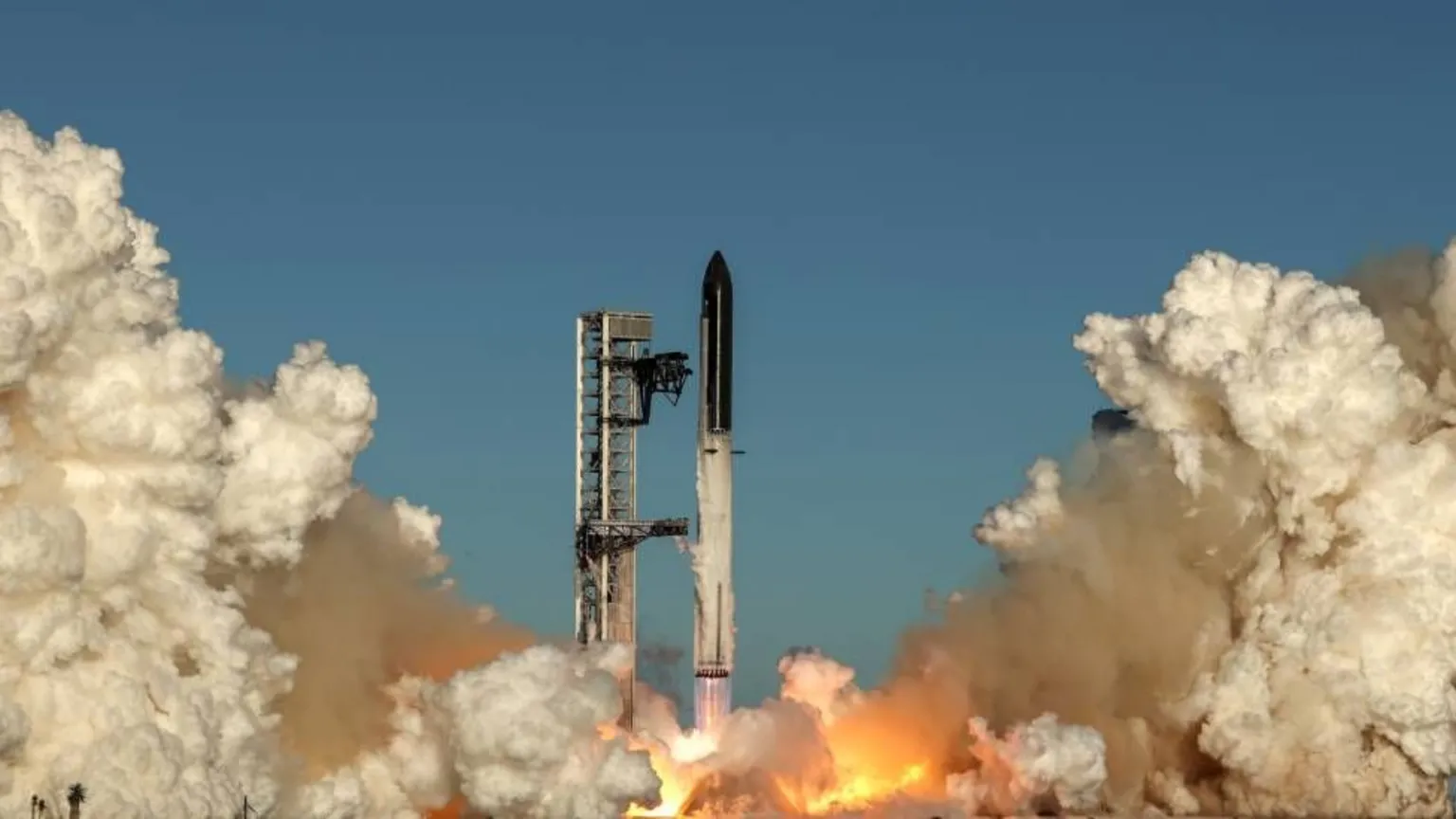
In a significant achievement for space exploration, SpaceX has successfully captured the upper stage of its massive Starship rocket for the first time. This momentous event followed a flight lasting 22-and-a-half hours, culminating in the rocket’s return to Earth where it hovered near the launch tower in Boca Chica, Texas. The mechanical arms of the tower, affectionately known as ‘chopsticks,’ secured the upper stage upon its return.
This test marked the 15th flight of the Starship, with the primary goal of recovering both the upper and lower sections of the rocket. Although the attempt to catch the Super Heavy booster, the lower part of the rocket, was aborted shortly after launch, the successful recovery of the upper stage marks a pivotal step towards SpaceX’s goal of achieving full reusability of the Starship.
Details of the Launch and Recovery
The Starship rocket launched successfully from the Starbase launchpad at 16:47 local time on Friday. The initial plan included capturing the Super Heavy booster approximately six-and-a-half minutes post-launch; however, the booster experienced an automated abort and was diverted to the ocean, where it eventually exploded.
Despite this setback, the upper stage continued to perform its mission, deploying 26 satellites that contribute to the Starlink constellation, which provides high-speed internet services. The upper stage completed 14 orbits around the Earth before returning to the launch tower, showcasing the rocket’s capabilities.
Elon Musk, the CEO of SpaceX, noted that the booster was slightly low on fuel, which contributed to the abort. SpaceX had previously succeeded in catching the Super Heavy booster during three earlier tests, but this was the first instance of the upper stage being successfully captured.
Future Implications for SpaceX and NASA
SpaceX’s advancements in rocket recovery are crucial for its long-term plans to create a fully reusable rocket system. This technology is expected to significantly reduce launch costs and increase the frequency of space missions. Experts, including Prof. Malcolm Macdonald, president of the Royal Aeronautical Society, have commented on the implications of these developments for the future of space travel.
With NASA closely monitoring the progress of SpaceX’s Starship, the successful recovery of the upper stage is a promising sign as the agency works towards its ambitious goal of landing humans on the Moon by 2028. SpaceX has been contracted by NASA to adapt the Starship into a lunar lander, which will play a vital role in upcoming missions, including the Artemis III mission planned for summer 2027.
As both SpaceX and its competitor Blue Origin move forward, the race to the Moon intensifies, with both companies facing their own unique challenges. The successful recovery of the Starship’s upper stage is a hopeful indicator of the advancements to come in space exploration.